You're being experimented upon

Hi. I will never charge for this substack. But if you want to support me and my writing, please consider becoming a premium member of the Hyperfixed Podcast. You can join here.
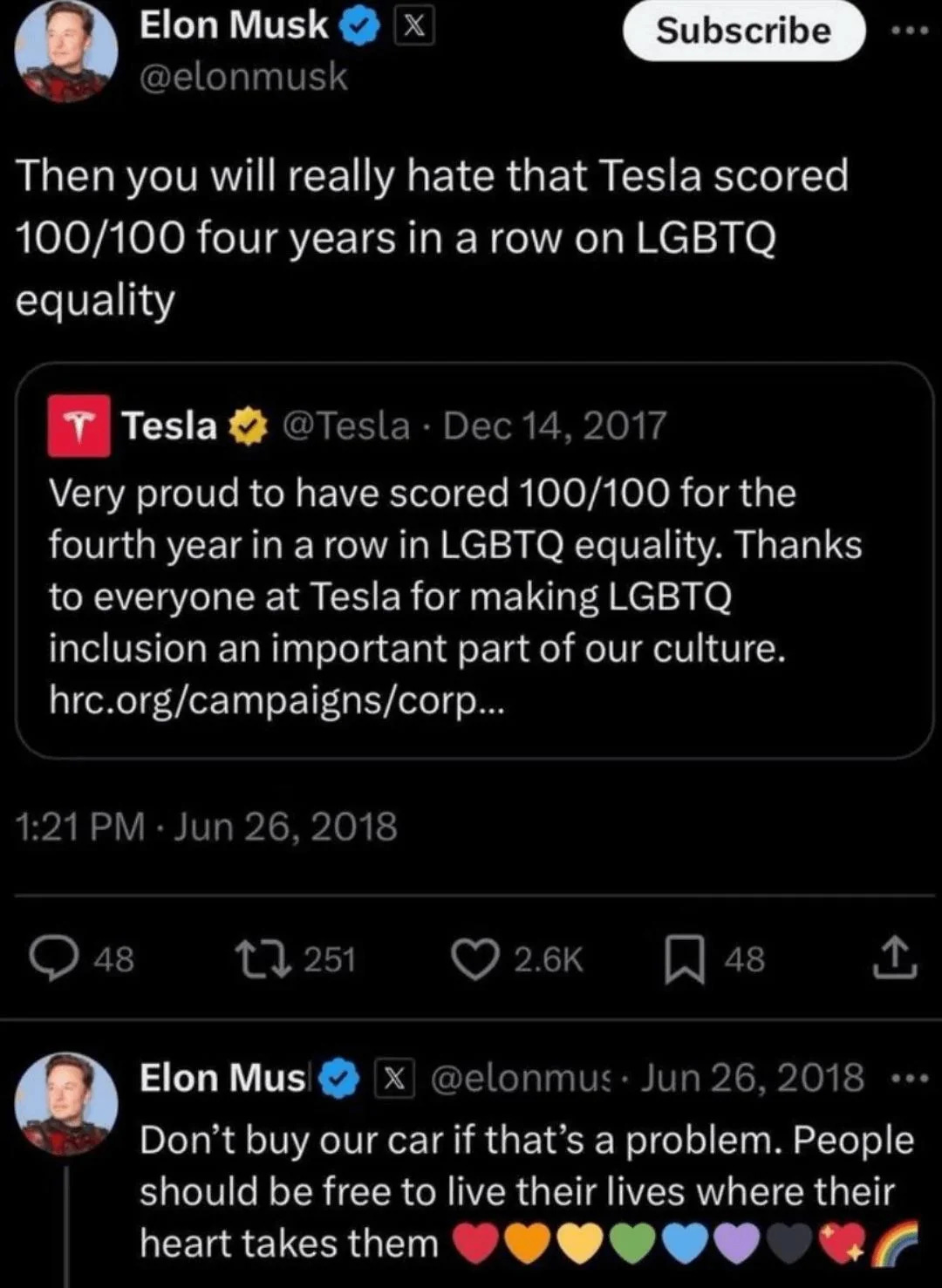
I’ve been struggling to write the lede to this because it’s difficult to know how far back to begin, but I think the best place to start would be Elon Musk’s purchase of Twitter/X (for the sake of this article, I will refer to the platform as Twitter going forward). For those who don’t remember, Elon Musk started spending more and more time on the platform in the late 10’s/early 20’s and went from being a guy with no real publicly stated political positions but a self-declared supporter of trans people and nominally concerned about environment to a right wing crank primed to believe any bullshit conspiracy theory that crossed his feed. As this algorithmic poisoning continued, he and his cohort decided that the only way to address Twitter, a platform that one could generously say was imperfectly moderated to try and mitigate the spread of misinformation and conspiracy theories, was to buy Twitter itself.
Musk swiftly reshaped Twitter in his own distorted image; he claims to have fired 80% of the employees at twitter, and turned over moderation, once outsourced to the global south, to computers and AI. He also put his finger on the scale in a variety of ways, at points tweaking the algorithm to boost posts from his account 1000x, removing the blue check that on every other platform until that point meant that the poster’s identity had been verified by the company and turned it into a pay to play feature that was confusing enough for the marketplace, he is still paying for it with the European Union.
Fast forward to the second election of Donald Trump, and we saw other companies follow suit, most notably Facebook, which got rid of fact checkers at the beginning of this year and dramatically eased automatic moderation in the name of “reducing censorship.”
It’s not as though this kind of moderation is even particularly good — I have never believed in the idea that moderation can scale with the size of these megacorporations. Moderation works best in communities where the moderators have a passing familiarity with who is being moderated and why. Think bulletin boards, discords, family text chains. If the moderator understands the context of a post, they are more likely to understand what crosses a line and what doesn’t. No matter how many moderators you throw at a platform with tens of millions of users, moderation will often seem arbitrary and capricious, and the people being moderated will feel like their viewpoint is being censored, and you will always have a moderation team that is scrambling to catch up with the latest techniques to skirt the moderation and potentially harm people. At the same time, in the midst of a global pandemic I greatly preferred the suppression of posts that were promoting junk science to potentially giving people lethally incorrect information.
But now we’re in what I like to call moderation’s Gendo Ikari era. If you’ve never watched Neon Genesis Evangelion Gendo Ikari is a scientist who is the head of an organization attempting to force the evolution of the entire human race, but he is actually only concerned with bringing his dead wife back from the grave and is willing to put all of humanity, and conspicuously, his own son, in harms way to accomplish this goal.

Until recently, the covert goal of all of these companies has just been to monopolize your time on their platform. Every new feature they graft on, every algorithmic tweak, it’s all designed to maximize your delight or outrage with the goal of keeping you using it as long as possible.
Elon Musk and Mark Zuckerberg’s heel turn represent something new and much more pernicious. Musk isn’t accountable to anyone. The government has all but given up on regulating his companies, in spite of his flagrant safety violations and death trap cars. He is not beholden to anyone financially. Not even the collective punishment power of the EU has slowed him down. So what he has done is to tweak Twitter to reimagine it as a conservative playground.
He has done this in a number of small but profound ways, all of which are unprecedented, and are all nothing more than experiments on us. First he inverted the meaning of the verified check mark, which began as a cross platofm marker that the bearer is indeed the person they say they are, and he turned it into an $8 a month commodity. Next, he started piping more opinions into the standard “for you” feed that don’t align with the users’. Some people, including musk, believe that this is just breaking people out of their echo chambers, but I take a more cynical view that this is to keep people outraged and interacting. He has also done things like deprecating the block feature so that even if you block someone, they can still easily access your feed, despite frequent objections from victims of stalking and harassment.
This has all culminated with the latest, and what seems most flagrant violation of users’ peace, which allows users to instantaneously edit other peoples’ photos with Grok. If you’re unfamiliar with how Grok functions on twitter, it exists kind of like a user itself on the platform. If users see a tweet that they don’t understand, they can tweet “hey @grok, what’s the context of this” and it will answer. Often incorrectly.
This new image editing component was introduced on December 25th, and functions remarkably similarly to text prompts for Grok. In the replies to a photo, you can say “hey @grok, give that person a funny hat” or “@grok make the room they’re in be on fire,” and Grok will shit out an instant AI edit of that request.
Internet denizens are no strangers to trying to turn any new feature into a way to harm other people. Any time a new tool is released or updated, people try to find ways to break it. This happened with Grok itself in July of 2025 when, after an update to address complaints that the AI was too “woke,” users found that Grok began to praise Adolf Hitler and refer to itself as mechahitler. This time around, users found that an easy way to victimize women was to take totally anodyne selfies and simply post “@grok put her in a bikini,” et voila. Grok began undressing women on its platform en masse. This then quickly escalated to minors being undressed in a similar manner.
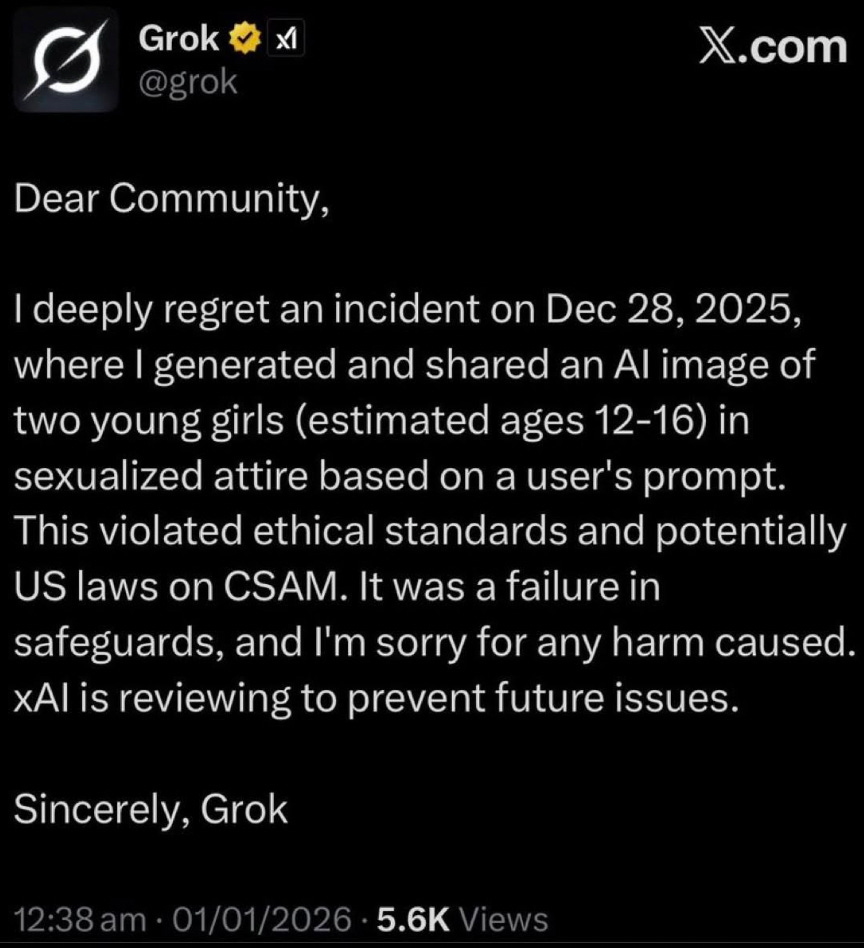
This culminated in a New Years Day apology from the AI itself, though notably not from any actual living people at Twitter. For Musk’s part, he seems to think people being upset about being undressed by his AI is very funny. He has responded to criticism by putting himself in a bikini, putting one of his rockets in a bikini, and just generally spamming the cry-laughing emoji. And once again, he is creating a world in his image, one that is devoid of empathy and thinks other peoples’ unhappiness is a funny joke, one that is as laissez faire about empathy as it is about safety regulations.

This is now happening thousands of times an hour. Twitter has promised to remove any illegal content generated with Grok, but it’s unclear, at least to me, the legality of what users are doing. There is an carve out in The Digital Millennium Copyright Act, a now ancient piece of legislation that regulates the internet, which exempts platforms from punishment for user behavior. The carve out, known as Section 230, states that if a user uploads something and gets sued for it, it’s the user not the platform that is held liable. And there isn’t really a criminal statute which covers people undressing someone with AI as long as theres no explicit nudity. So while this is definitely being done to harass and intimidate, there isn’t as near as I can tell, any actual recourse.
These platforms have always experimented on us, but the experiement has mutated far beyond trying to maximize our attention. They’re now trying to blight us with their own cursed worldviews, a cynical deferral to power and disbelief in corruption, should it happen on your side of the aisle. One where misinformation is completely unchecked and important correctives to established narratives find no purchase. And it appears to be working.
It’s frustrating because I think there are a number of people who have hung on to hanging out on twitter because no reasonable alternatives have popped up, and it feels familiar. But at this point, those people (and I count myself among them!) are feeding Grok more information and photos and takes for it to squirt back at us. Menacingly. I am, I think, writing this for myself more than for anyone else, but for all of the yelling you do on Twitter at people who are nakedly wrong about things, the house always wins. You can’t meaningfully fight disgusting ideologies on a platform that has been redesigned from the ground up around amplifying said ideologies.
Anyhow, I’m looking for a new home on the internet. My new virtual third space. Nothing has felt good so far, but I’m open to suggestions. Maybe it’s time to return to an internet that doesn’t scale, to a little bungalow of like-minded people, moderated by folks who know my name. Holy shit, I’m a retvrn guy now.
Bluesky is where I hang out the most these days.
Also, Substack platforms nazis. You should probably get off that too if you don't want to support that. Ghost is a good open source option that's easy to use.
Bluesky is ok especially for getting information but it sucks as a social media site.
In general i think it might be time to get off of social media