Hyperfixed Live In Brooklyn + More
Also some reflection on the state of the internet.

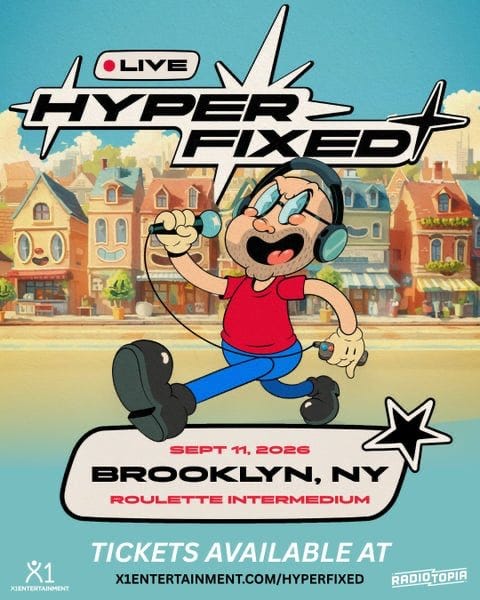
Hey there, Substack nation. Before I go any further, I just wanted to let you all know I’m doing a live show in September in Brooklyn and I would love to see you there. You can get tickets at tickets.hyperfixedpod.com. We’re going to be premiering a new story, as well as doing some fun audience stuff that can only happen live. Also hyperfixed premium members will get 10% off So if you can make it, we’d love to see ya!
Ok, now that that’s over with — it’s been a minute since I’ve posted on here for a number of reasons. Part of the reason I have never asked for money over here is because I’ve never really known what this space was supposed to be. It’s kind of amorphous, and I can occasionally take advantage of it to write about whatever’s on my mind. Historically it’s been a place where I have posted about the cost of making a podcast, but there’s so little to say with respect to that, and the actual work of making the podcast has consumed what little spare brain space I have to actually write about the work of making the podcast for the time being.
I have also found myself just kind of souring on Substack as a platform, which I think is the case with just about every platform I use these days — I am pretty ambivalent about monetization on a platform that enriches fascists and with as much vigor as Substack does, especially seeing how unrepentant the owners have been. Which actually got me thinking about the internet of 2026 as a person who spent over a decade covering the internet, and how I would cover it today.
And honestly, I think the short answer is that I wouldn’t. The internet feels like it has lost its way in so many discrete and painful ways, it’s really hard to think how I could make something that felt like Reply All in 2025. I mean, the big sites have so completely squeezed out the niche internet communities, it feels like everything happens on maybe 5-10 websites. Think Google, Reddit, Twitter, Meta, Tiktok, and Amazon. The lush environments that allowed for weirdness and excitement and, honestly, for community, have gone by the wayside. And the ones that remain are shadows of their former selves.
there was a point in time in which new media attempting to grab legitimacy by attempting to imitate old media, and The Washington Post and CBS have shown us it’s now the other way around. And that is to our detriment.
Think about the Twitter, Facebook, and Instagram of 2014 or 2015 vs. now. Those sites were made to sell ads, sure, but they were made with user experience in mind. And that design philosophy slowly, over the course of the past decade, has shifted in favor of design for ads. Most of the people in my instagram feed are strangers. Most of the tiktoks I get are ads. Twitter prioritizes ads and white supremacy.
There is a part of me that looks back at the work we did for Reply All and that we were total Pollyannas, not interrogating the behavior and decisions of companies like Meta (especially Meta, in my internet cosmology they have engaged in some really heinous behavior) as they consolidated the internet and saw internet traffic as a zero sum game that had to be stolen by hook or by crook from other platforms. Maybe it was worth saying in the moment that as the lanes on the internet narrowed down to these gigantic websites, there is a reason the internet feels less like home and more like being accosted by the poor folks manning the kiosks at an oppressively busy mall. Everything, from humor to outrage is put in front of us as a way to keep us scrolling specific sites.
I bring this up as Google has announced its plans for the future of search - it wants to completely remove its search algo from the equation and instead let Gemini (its AI model) do all the searching instead, allowing it to “generate a custom page with an AI-generated summary of what you’re searching about, which will then trigger a conversation with AI Mode on the main page, allowing users to ask follow-up questions,” according to Rebecca Schneid in Time Magazine.
This is one of those that might not register as anything other than a “huh, that’s interesting, who cares?” for a lot of people. But think less about the function and more about the follow-on effects of this. The goal of doing this is for people to engage only with Google’s site, which is now using AI that has scraped the internet of all its knowledge and can answer questions for you (sometimes extremely incorrectly) without you having to find the original information at all. Just like the “AI summaries” that have been on Google for a few years, this will have the effect of keeping people on Google.
But — if no one has any reason to make their own sites anymore, what will Google pull knowledge from? Who will be creating new information for the search engine to gobble up? News outlets? A lot of the major news outlets are behind paywalls, and not only that, hundreds of them are now exempting their sites from being preserved by the Internet Archive.
I get the business impetus for this — why buy the cow when you get the milk for free or whatever the saying is. But these archives are invaluable when it comes to factchecking claims from public figures, and creating a historical record that is accessible outside of public libraries, which also face their own peril. Not only that, they’re used by only the nerdiest of people. They are slow to load, user unfriendly, and difficult to access. But why would a corporation do something to benefit the public good when there’s money to be made for shareholders?
As our culture becomes more atomized, so too does the internet. The promise of a neutral carrier of information founded on principles of preserving and advancing public knowledge is over with, completely captured by moneyed interests who are running psychological experiments on how much advertising we’re willing to tolerate and tracking our every move online so they can then package it up and sell it. And with the proceeds these couple of companies have amassed as moguls, they have invested in stuff like destroying the Washington Post and destroying CBS and turning Twitter into a misinformation machine that is tuned to the richest man in the world’s specific political frequency.
I have been on both sides of the old/new media divide. I started in public radio in 2010, and then went to a startup that was sold for an astronomical amount and now I’m completely independent, and I don’t think one or the other has a monopoly on good or bad reporting. But there was a point in time in which new media attempting to grab legitimacy by attempting to imitate old media, and The Washington Post and CBS have shown us it’s now the other way around. And that is to our detriment.
As usual, I don’t have a panacea for this problem, and expect it to continue apace. It’s just a thing I’ve been feeling. I hope it was worth your time and it makes you think about how (and why) (and where) you engage with the internet these days. Even if it doesn’t change your habits, just observing it seems worthwhile.
I think a lot of the (good bit of the) internet has moved into semi-private little islands such as Discord and Slack servers.
When the internet started we were all so excited to share everything about ourselves and the newer generations who grew up with it were all "naah". The big companies have been sucking up all the content that was shared for free and turning it into profit but that is coming to an end now.
The next step will be AI but AI will struggle because of garbage-in-garbage-out (GIGO). As professionals find that their work is being used to make them redundant, there will be a backlash and AI models will become less effective.
At the moment it is mostly creative professionals - artists and musicians - but it will extend to anyone who produces content of any kind including professionals such as lawyers, consultants, doctors, etc.
I'm not terribly sad about this change. People are more comfortable on Discord and discussion is a lot more open and candid even if it is only semi-private. AI bots can't just swoop in and steal the output and understand the context.
It does increase the amount of work you need to take to be a part of the conversation (get invite etc) but it is not too difficult.
For kids that have had their entire life documented on The Facebook and Instagram and are on camera pretty much all day long and whose every move is logged somewhere.. a more private internet is what they want. I'm with them. :)